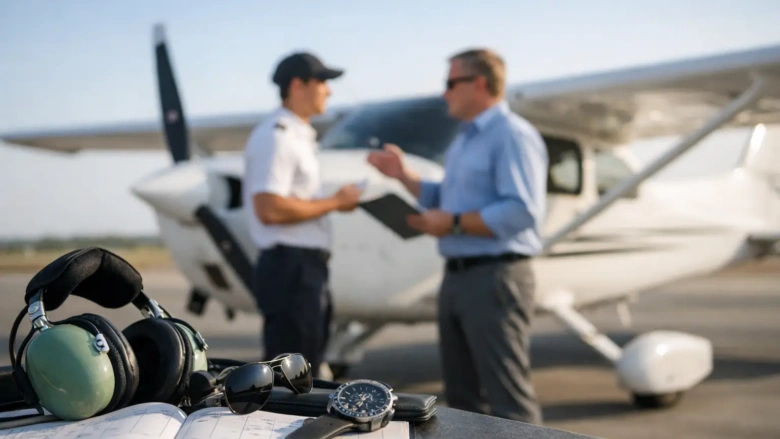
Your first solo does not happen because a calendar says it should. It happens when you can consistently control the aircraft, make sound decisions, and meet FAA standards without an instructor beside you. That is the principle behind an accelerated private pilot training timeline: train often enough that each lesson builds directly on the last, while protecting the safety and judgment that define a capable pilot.
For a committed student with flexible availability, private pilot training can often move from first lesson to checkride in roughly three to six weeks. That pace is achievable, but it is not automatic. Aircraft availability, weather, lesson preparation, instructor scheduling, medical readiness, and your ability to absorb new material all influence the actual schedule.
What an Accelerated Private Pilot Training Timeline Looks Like
An accelerated program compresses the training calendar, not the FAA standards. You still must demonstrate the same knowledge, maneuvers, aeronautical decision-making, cross-country planning, and practical test readiness required of every private pilot applicant.
Under an FAA-approved Part 141 private pilot course, the minimum flight-training requirement may be 35 hours. Under Part 61, the minimum is 40 hours. Those are regulatory minimums, not promises that every student will be ready at that number. Many pilots need additional time to reach consistent proficiency, especially in landings, cross-country procedures, radio communication, or checkride-level decision-making.
A realistic full-time schedule typically includes one or two flight lessons most days, supported by structured ground school, instructor briefings, simulator practice when appropriate, and independent study. Training four or five days per week allows you to retain sight pictures, radio flow, maneuver setup, and cockpit procedures. Instead of spending the first half of every lesson relearning material from last week, you can move forward.
Week One: Foundations and Aircraft Control
The first phase establishes habits that will carry through every rating you earn afterward. You will learn preflight inspection, cockpit organization, checklists, basic aerodynamics, taxi procedures, normal takeoffs and landings, climbs, descents, turns, slow flight, and stall awareness.
For many new students, this is the most mentally demanding period. Flying requires you to manage the airplane, listen to air traffic control, monitor airspace, and stay ahead of the aircraft at the same time. Early training can feel intense, particularly in Southern California airspace, where radio communication and traffic awareness become part of daily flying. That environment can also build valuable confidence quickly when training is well structured.
By the end of this phase, the goal is not simply to complete maneuvers. It is to develop repeatable procedures. A student who uses a consistent checklist flow, makes stabilized approaches, and understands what the airplane is doing will progress faster than a student trying to memorize isolated actions.
Week Two: Solo Readiness and Local Solo
Once your instructor sees consistent aircraft control and sound judgment, training turns toward solo preparation. You will refine takeoffs and landings, practice emergency procedures, learn airport operations in greater depth, and demonstrate that you can safely operate within the limits of your endorsements.
The first solo is a major milestone, but it is only one part of the private pilot course. After solo, you continue to build confidence through supervised solo practice and dual instruction. The FAA requires specific solo experience, including solo cross-country flight, and your instructor must verify readiness before each new phase.
Students often ask whether they can solo on a fixed day. The honest answer is no. A strong accelerated program plans aggressively, but a responsible instructor never forces a solo to satisfy a marketing schedule. If landings or decision-making need more work, an extra lesson is progress, not failure.
Weeks Three and Four: Cross-Country Training
Cross-country flying is where private pilot training starts to feel like real transportation. You will plan routes, calculate weight and balance, review weather products, select fuel stops when needed, navigate with visual references and avionics, communicate with controllers, and manage changing conditions away from your home airport.
This phase includes dual cross-country instruction followed by required solo cross-country flights. It also brings more weather-related variables into the timeline. Low ceilings, high winds, heat, turbulence, or temporary airspace restrictions can alter a planned flight. A productive academy uses those changes as training opportunities, while maintaining enough aircraft, instructors, and schedule flexibility to avoid unnecessary downtime.
Modern Garmin-equipped aircraft can support situational awareness and navigation, but they do not replace pilot judgment. You will need to understand the system, verify its information, and retain the ability to navigate and make safe decisions when the plan changes.
The Final Phase: Checkride Preparation
The final week of an accelerated course is usually devoted to polishing, not cramming. You will complete remaining flight and knowledge requirements, take practice exams, review weak areas, and conduct a mock checkride with your instructor. The practical test includes an oral evaluation and a flight portion with a designated pilot examiner.
A checkride-ready student can explain weather risks, airspace rules, aircraft systems, performance limits, required documents, and personal minimums. In the airplane, that same student can fly to standards while staying calm, organized, and safety-focused. The examiner is evaluating more than maneuver precision. They are evaluating whether you can exercise the privileges of a private pilot responsibly.
Your written knowledge test should be completed before the final push whenever possible. Waiting until the end of a compressed course to begin serious test preparation creates avoidable pressure and can delay the checkride. Online ground school, instructor-led review, and regular practice tests make the workload more manageable.
What Can Speed Up or Slow Down Training?
The best accelerated private pilot training timeline depends on consistency more than raw talent. Students who arrive prepared, study between lessons, and protect their training blocks generally finish sooner than students who rely on flight time alone.
Four factors deserve particular attention:
- Training frequency: Flying several times each week improves retention and reduces the review required at the start of each lesson.
- Aircraft and instructor access: A reliable fleet and coordinated scheduling help prevent a stalled training calendar when an aircraft needs maintenance or an instructor is unavailable.
- Preparation outside the airplane: Completing assigned reading, chair-flying procedures, reviewing maneuvers, and preparing cross-country plans keeps paid flight time focused on flying.
- Personal readiness: A delayed medical certificate, fatigue, financial interruption, or difficulty managing a full-time work schedule can extend even a well-designed course.
Weather is another variable, and it should never be treated as an inconvenience to be pushed through. Safe accelerated training requires sound go or no-go decisions. If a crosswind exceeds your current ability or visibility does not support the lesson objective, the right move may be a simulator session, ground lesson, or reschedule.
How to Prepare Before Day One
You can create momentum before you ever start the engine. Schedule an FAA medical examination early, especially if you have a medical history that may require additional review. A third-class medical certificate is generally required before solo flight, although students can begin dual instruction before receiving it.
Set aside training time that is genuinely protected. A three-week course demands more than showing up for the flight itself. Expect briefing, debriefing, study, meals, rest, and occasional schedule adjustments. If you are balancing work or college, a longer accelerated format may be more practical than trying to force a full-time schedule.
It also helps to arrive with a clear financial plan. Flight training costs vary with aircraft type, fuel, insurance, instructor time, the number of hours needed, and examiner availability. Training consistently is often more cost-efficient than stopping and restarting, but the cheapest schedule is not always the fastest. The right plan gives you enough margin to train to proficiency rather than chasing a minimum-hour target.
Is Accelerated Training Right for You?
Accelerated training is a strong fit for career-minded students, college-age learners on a focused break, and adults who can step away from work long enough to make aviation their primary commitment. It can also suit motivated recreational pilots who want to earn their certificate without stretching training across a year.
It may be less suitable for someone who can fly only once or twice a month, is not yet ready to commit to regular study, or prefers a slower pace to build confidence. There is no penalty for choosing the timeline that supports better learning. The objective is not to finish first. It is to finish prepared.
At Riverside Flight Academy, structured Part 141 training, experienced instructors, simulator support, and access to a modern fleet are designed to keep committed students moving toward that goal. Bring the discipline to prepare, fly consistently, and ask questions early. Your timeline will become more than a date on a calendar – it will become the runway to confident, independent flying.