A commercial pilot training program is where aviation stops feeling like a distant goal and starts becoming a profession with measurable milestones. For many students, this is the point where the question shifts from “Can I learn to fly?” to “How efficiently can I build the skills, hours, and credentials needed for paid flying?” That shift matters, because commercial training is not just about handling an airplane well. It is about building judgment, consistency, and cockpit discipline to a professional standard.
What a commercial pilot training program is really designed to do
At a basic level, commercial training prepares a pilot to meet FAA requirements for a Commercial Pilot Certificate and to operate with a higher degree of precision than private flying demands. In practice, that means sharper aircraft control, better aeronautical decision-making, stronger situational awareness, and the ability to perform under more structured evaluation.
This is also where many students begin thinking seriously about the larger career path. A commercial certificate can open the door to jobs such as aerial survey, banner towing, pipeline patrol, skydive operations, and some entry-level charter-related roles, depending on the operation and insurance requirements. For students aiming at the airlines, commercial training is a major checkpoint, but not the final one. Most will continue on to flight instructor, multi-engine, and eventually ATP-level preparation.
That distinction is worth keeping in mind. A commercial certificate makes you eligible to be paid for certain flying, but your long-term career options depend on the rest of your training plan, your total time, and the kind of experience you build next.
The stages inside a commercial pilot training program
Most students do not start commercial training from zero. They usually move through a sequence that begins with Private Pilot, then Instrument Rating, then Commercial Pilot. If the goal is a professional cockpit, flight instructor certificates and multi-engine training often follow soon after.
Private Pilot comes first
Private training builds the foundation. You learn the basics of aircraft control, takeoffs and landings, airspace, radio communication, navigation, and FAA operating rules. This stage is where students prove they can manage the airplane safely and consistently in normal training conditions.
Without a strong private foundation, everything later becomes slower and more expensive. Students who rush through early habits often end up paying for it during instrument and commercial training when standards get tighter.
Instrument Rating changes how you think
Instrument training teaches precision in a different way. Instead of relying mainly on outside visual references, you learn to fly by reference to instruments, manage complex procedures, and maintain accuracy in altitude, heading, and approach profiles.
For career-track students, this rating is not optional in any practical sense. Even when the FAA sequence can vary based on school structure, instrument knowledge strengthens every part of commercial training. It also makes a pilot more useful, more employable, and far better prepared for real-world flying.
Commercial Pilot training raises the standard
Commercial training is where your flying is expected to look more polished and professional. The FAA standards include advanced maneuvers, tighter tolerances, and a stronger emphasis on aircraft control through all phases of flight. You are not just proving that you can complete a maneuver. You are showing that you can do it smoothly, accurately, and with sound judgment.
A good program also emphasizes the practical realities behind the checkride. You should be learning how to brief clearly, think ahead of the airplane, manage risk before it grows, and fly with a level of discipline that supports future employment.
What the training actually includes
The details vary by school, aircraft type, and whether training is conducted under Part 61 or FAA-approved Part 141, but most commercial training includes a mix of ground instruction, simulator work when appropriate, and in-aircraft flight lessons.
Ground training covers aerodynamics, commercial privileges and limitations, performance calculations, regulations, weather interpretation, systems knowledge, and scenario-based decision-making. This part matters more than many students expect. Weak ground knowledge tends to show up in the cockpit as hesitation, poor planning, or avoidable workload.
Flight training focuses on the maneuvers and operational skills required for the certificate. That includes chandelles, lazy eights, steep spirals, eights on pylons, precision takeoffs and landings, and stronger command of cross-country planning and aircraft performance. You are also building total flight time, because FAA commercial eligibility depends not only on skill but on logged experience.
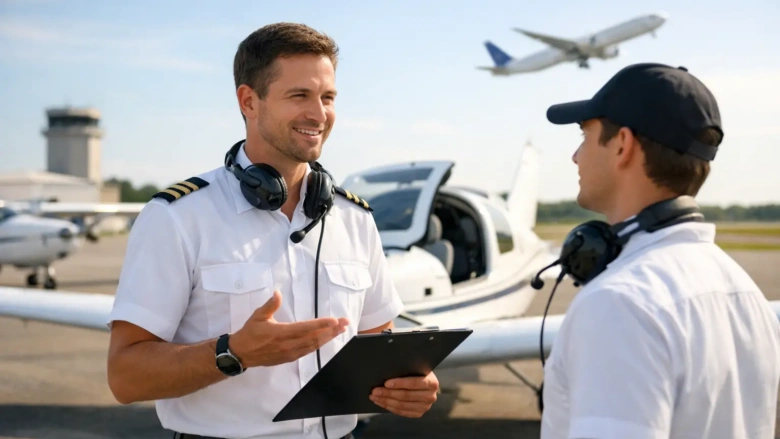
At a professionally run academy, structure makes a visible difference. Students progress faster when aircraft availability is dependable, maintenance downtime is managed well, and instructors teach from a clear syllabus instead of improvising from lesson to lesson. That is one reason many career-minded students prefer a more organized training environment over a casual pay-as-you-go approach.
Part 141 vs Part 61: why the difference matters
A structured commercial pilot training program is often offered under Part 141, which means the FAA has approved the curriculum, lesson sequence, and training standards. For the right student, this can create better pacing, clearer accountability, and less wasted time between milestones.
Part 61 can still be effective, especially for students with unpredictable schedules or prior experience. It offers more flexibility, but flexibility is not always the same as efficiency. If your goal is professional flying on a defined timeline, structure usually helps.
This is especially true for students balancing financing, school, work, or family commitments. A clear syllabus, regular progress checks, and consistent instructor guidance can reduce the stop-and-start pattern that stretches training out and increases cost.
Timeline and cost depend on consistency
One of the most common questions students ask is how long commercial training takes. The honest answer is that it depends on where you start, how often you fly, and how efficiently the school operates.
A student coming in with no experience is not enrolling in only a commercial course. They are starting a full professional pathway that may include Private Pilot, Instrument Rating, Commercial Pilot, and often Certified Flight Instructor training after that. In an accelerated environment, that path can move much faster than many people expect. In a slower schedule with long gaps between lessons, the same path can drag on for months or even years.
Cost follows the same pattern. The hourly price of aircraft and instruction matters, but so does training efficiency. A lower advertised rate does not always mean a lower total cost if scheduling is unreliable, aircraft are frequently unavailable, or students need repeated review because of inconsistent lesson flow.
For that reason, serious students should evaluate total training value, not just hourly numbers. Fleet access, instructor quality, simulator support, and operational organization all affect how much training you ultimately need.
What to look for in a school
Choosing a school for commercial training is not just about passing a checkride. It is about choosing the environment that will shape your habits as a professional pilot.
Look for a program with a clear training sequence, modern avionics, and instructors who understand both FAA standards and career progression. A school should be able to explain how students move from one certificate to the next, where common delays happen, and how they help reduce those delays.
Aircraft availability matters more than glossy marketing. If students cannot get on the schedule, progress stalls. Simulator access also matters, especially for instrument proficiency and procedural repetition. Financing options and educational partnerships can be meaningful too, especially for students building a long-term career plan rather than buying isolated lessons.
In Southern California, where airspace complexity and weather variety can create strong training value, a professionally managed school can give students experience that translates well beyond the local area. That does not mean every student needs the same pace or path. Some want an accelerated route to instructor certifications. Others need a schedule that works around college or a full-time job. The right school should be able to support both without losing structure.
The bigger picture after the commercial certificate
A commercial certificate is a major achievement, but it is usually one step in a larger professional plan. Many pilots build hours by becoming instructors. Others add multi-engine training to expand future job options. If the airline path is the goal, commercial training should fit into a timeline that eventually leads to ATP eligibility.
This is where mentorship becomes valuable. The best training programs do more than teach maneuvers. They help students understand what comes next, what employers tend to value, and how to make smart decisions about time-building, ratings, and readiness.
At Riverside Flight Academy, that career-oriented structure is a big part of the training philosophy. Students are not just learning to pass a test. They are developing in an environment built around progress, professionalism, and the next certificate ahead.
The right commercial pilot training program should leave you with more than a new line on your certificate. It should give you momentum – the kind that makes the next phase of your aviation career feel earned, realistic, and close enough to chase now.