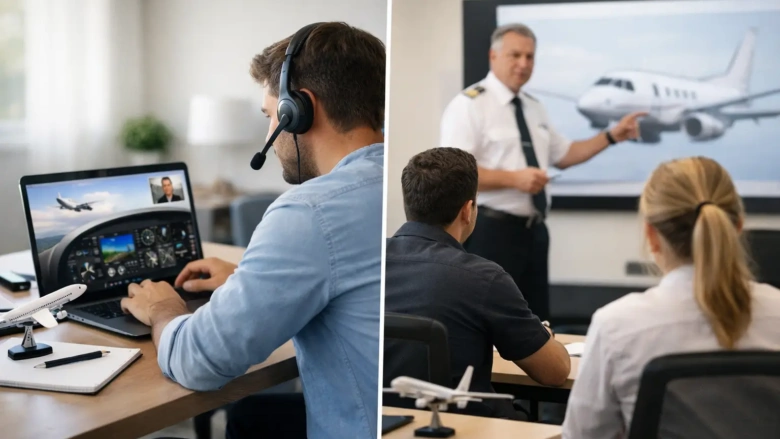
A weather cancellation does not have to become a lost training day. When low clouds, wind, maintenance, or aircraft scheduling keep a student on the ground, a quality simulator can keep key skills moving forward. But do simulators count for flight training in the way most students mean it: toward certificates, ratings, proficiency, and a professional pilot career? The answer is yes, within FAA limits and when the device, lesson, instructor, and training program meet the right requirements.
When Simulator Time Counts Toward FAA Training
A simulator is not automatically interchangeable with an airplane. The FAA distinguishes between several types of training devices, including Basic and Advanced Aviation Training Devices, Flight Training Devices, and full flight simulators. Each has its own approval, capabilities, and allowable training credit.
For a student, the practical point is straightforward: time in an FAA-approved device can be credited toward certain training requirements when it is conducted properly and documented by an authorized instructor. The amount of credit depends on the certificate or rating you are pursuing, the type of device being used, and whether your program operates under Part 61 or an FAA-approved Part 141 curriculum.
That distinction matters. Part 141 schools use structured, FAA-approved syllabi that specify how simulator sessions fit into each course. This can create an efficient path because the device is integrated into the lesson sequence rather than treated as an occasional add-on. Under Part 61, simulator credit can also apply, but the applicable regulation and the instructor’s documentation determine what counts.
No responsible school should promise that every minute in a simulator replaces airplane time. Aircraft experience remains essential, especially for takeoffs, landings, visual references, aircraft handling, weather judgment, and the real-world decision-making that comes with operating in the National Airspace System. The simulator is most valuable when it is used for the work it does better than an aircraft.
Do Simulators Count for Flight Training at Every Stage?
They can, but the value and allowable credit change as your training advances.
For private pilot students, an approved training device may be used for a limited portion of the required aeronautical experience. It is particularly effective for learning cockpit flows, navigation procedures, radio communications, basic instrument reference, and emergency response before practicing those skills in the airplane. A student who has already rehearsed a lesson often spends less aircraft time trying to remember the sequence and more time building real control skills.
For instrument students, simulator training becomes even more central. Instrument flying is procedural by nature. You need to scan instruments, interpret approaches, manage avionics, communicate with air traffic control, brief a missed approach, and make good decisions when the workload rises. A simulator allows an instructor to pause, reset, repeat, and create scenarios that would be impractical or unsafe to manufacture in flight.
FAA regulations permit meaningful simulator credit toward instrument training, subject to device-specific limits. In general, a higher-fidelity FAA-approved device can receive more credit than a basic device. Your instructor should explain exactly how each session will be credited before training begins, rather than leaving you to decode logbook entries later.
Commercial and instructor applicants also benefit from simulator sessions, even where the certification requirement still calls for substantial aircraft time. Commercial training demands precision and consistency. Flight instructor training demands that you explain, demonstrate, and correct maneuvers while maintaining situational awareness. Rehearsing these tasks in a controlled environment can make aircraft lessons more productive.
For multi-engine and advanced training, a simulator can be especially useful for engine failures, abnormal procedures, and high-workload cockpit management. These are not exercises to approach casually. Practicing the recognition, memory items, checklist discipline, and decision process before entering the aircraft helps students arrive prepared for a more focused flight lesson.
What Simulators Teach Better Than the Airplane
The best question is not whether a simulator is “as good as” flying. It is whether it is the right tool for the objective of that lesson.
A simulator is exceptionally good for repetition. An instructor can place you on the same instrument approach several times, introduce a communication failure at the same point, or reset an unstable scenario in seconds. In an airplane, returning to the same starting point may take 20 minutes, fuel, favorable weather, and coordination with air traffic control.
It is also a strong environment for Garmin avionics training. Modern avionics offer powerful tools, but proficiency comes from knowing what to do before workload builds. In a simulator, students can practice programming routes, loading approaches, changing frequencies, identifying navigation sources, and responding to system messages without the distractions and costs of an active flight.
Emergency and abnormal procedures are another major advantage. An instructor can safely present partial-panel operations, vacuum or electrical failures, deteriorating weather, engine problems, diverted routes, and missed approaches. The goal is not to create artificial stress for its own sake. It is to build a disciplined response: aviate first, verify the problem, use the checklist, communicate clearly, and make a sound decision.
Simulators are less effective for developing the physical feel of landing an airplane, judging a flare, sensing turbulence, or adapting to the subtle visual cues of a busy airport environment. Those skills demand time in an aircraft with a qualified instructor. A professional training plan does not choose one over the other. It assigns each tool to the job where it produces the most learning.
The Cost and Scheduling Advantage
Aircraft time is valuable because it includes the airplane, fuel, maintenance, insurance, and instructor time. Simulator sessions generally cost less than aircraft lessons, which can help students use their training budget strategically when approved credit applies.
The larger advantage may be continuity. Pilot training rewards frequent, deliberate practice. Long gaps force students to relearn tasks they had begun to master. A simulator can keep an instrument student current on approaches during marginal weather, let a private pilot rehearse before an upcoming cross-country, or allow a working adult to complete a focused evening session when daylight is limited.
That does not mean students should select a program solely because it advertises simulator time. Ask what type of device the school uses, whether it is FAA approved, how it is incorporated into the curriculum, and which requirements it can actually satisfy. Also ask whether the instructor will connect the simulator lesson directly to the next aircraft lesson. The answer should be specific, not a vague promise of saving time.
How to Get Real Value From Simulator Training
Treat a simulator appointment with the same preparation you would bring to a flight. Review the lesson objective, know the relevant checklists, study the route or approach, and arrive ready to make decisions. If the session begins with basic setup questions that could have been answered beforehand, valuable training time disappears quickly.
During the lesson, resist the urge to treat mistakes as inconsequential because the aircraft is not real. Use normal callouts. Follow checklists. Practice clear radio phraseology. If you miss an altitude or lose situational awareness, pause with your instructor, identify the cause, and fly the scenario again. The reset button is useful only when it supports deliberate improvement.
Afterward, write down the errors that repeated themselves and the procedures that need chair-flying before the next session. This is where simulator training becomes a multiplier. The goal is not to collect device hours. It is to arrive at the airplane with more capacity available for the parts of flying that can only be learned in the air.
A Professional Training Tool, Not a Shortcut
At Riverside Flight Academy, simulator training is most effective when it is part of a clear, pilot-led progression from first lesson through advanced ratings. The device supports structured preparation, skill reinforcement, and efficient use of aircraft time. The aircraft then confirms those skills where they matter most: in real weather, real airspace, and real command decisions.
If you are choosing a flight school or building your training plan, ask for a course-by-course explanation of simulator use and FAA credit. The right answer will show you both the opportunity and the limits. A simulator will not make you a pilot by itself, but used with purpose, it can help you become a more prepared, capable one every time you climb into the airplane.