If you are serious about flying for pay, a commercial pilot training guide should do more than explain FAA rules. It should help you understand what the training actually feels like, how the milestones connect, and where students tend to lose time, money, or momentum.
Commercial pilot training is not just a bigger version of private pilot training. The standard is higher, the flying is more precise, and the expectation shifts from safe personal flying to professional-level aircraft control and decision-making. That difference matters, especially if your long-term goal is airline, charter, corporate, or instructor work.
What commercial pilot training really leads to
A commercial pilot certificate allows you to be compensated for certain flying operations, subject to FAA rules and the type of work involved. For many students, it is the point where aviation changes from a goal into a profession. It is also not usually the final step.
Most career-track pilots earn their commercial certificate and then continue into flight instructor, multi-engine, and eventually ATP training. So while the commercial phase is a major milestone, it works best when it is built into a larger training plan. Students who treat it as a standalone rating often miss the bigger picture on time building, hiring pathways, and total training cost.
Commercial pilot training guide: the FAA path
The FAA allows more than one route to a commercial certificate, but most students follow a fairly predictable sequence. You typically begin with a Private Pilot Certificate, then add an Instrument Rating, and then move into Commercial Pilot training. Depending on your goals, you may add multi-engine training either during or after the commercial phase.
To qualify for a Commercial Pilot Certificate under FAA rules, you must meet age, language, aeronautical knowledge, and flight experience requirements. In most cases, students pursuing the airplane single-engine land commercial certificate need at least 250 total flight hours under Part 61. Under an FAA-approved Part 141 program, the minimum can be lower, but the structure is more formal and the syllabus is tightly organized.
That distinction matters. Part 61 can offer flexibility for students with irregular schedules or outside aircraft access. Part 141 is often better for students who want a defined training sequence, stage checks, and a more accountable pace. If your goal is career training, structure usually helps more than people expect.
The core skills you will be expected to master
Commercial training is built around precision. You are expected to fly to tighter tolerances, think ahead of the airplane, and demonstrate better judgment under workload. Maneuvers such as chandelles, lazy eights, steep spirals, eights on pylons, and power-off 180s are not there to make training look complicated. They are there to sharpen coordination, energy management, planning, and consistency.
You will also spend time refining takeoffs, landings, emergency procedures, cross-country planning, aircraft systems knowledge, and professional cockpit habits. A student can meet the legal hour minimum and still not be ready if those habits are underdeveloped. That is one reason aircraft availability, instructor continuity, and simulator support can make a real difference.
How long commercial pilot training takes
The honest answer is that it depends on where you start and how often you train.
If you already hold private and instrument ratings and are building time efficiently, the commercial phase itself can move quickly. If you are starting from zero time, the commercial certificate is part of a longer progression that may take many months or more than a year, depending on training frequency, weather, budget, and school capacity.
Students who train two or three times a week usually retain more and progress more smoothly than students who fly sporadically. Long gaps between lessons create repetition, and repetition adds cost. Accelerated programs can shorten the timeline, but only if the schedule is realistic and the student is prepared to treat training like a serious commitment.
In a well-organized school environment, momentum is everything. Access to instructors, aircraft, simulators, and a consistent syllabus can reduce downtime. That is often the difference between a student who finishes on plan and a student who stretches the same rating far beyond the expected timeline.
What this training costs and why estimates vary
Commercial pilot training is one of the larger investments in the aviation pathway, and cost estimates vary for good reason. The total depends on your current certificates, how many hours you already have, the aircraft you train in, local fuel prices, instructor rates, and how efficiently the program is run.
A low advertised number can be misleading if it assumes perfect performance, no extra training, and ideal scheduling. Most students need some amount of additional practice beyond the minimum. That is normal, not a failure. The right question is not whether a school advertises the lowest cost. It is whether the training plan is realistic and whether the school has the capacity to keep you progressing.
You should also pay attention to how the program uses ground instruction and simulation. Those tools can improve proficiency and reduce waste when they are integrated well. They do not replace aircraft time, but they can make aircraft time more productive.
Choosing the right commercial pilot training program
Not every school is designed for the same kind of student. Some are ideal for hobby pilots moving at a relaxed pace. Others are built for students who want a professional training environment and a direct route toward employability.
If you are evaluating programs, look beyond the sales pitch. Ask how often students actually fly, how stage checks are handled, whether aircraft are equipped with modern avionics, and how often maintenance or scheduling issues interrupt training. Ask whether the school can support your next step after commercial, because career-track students rarely stop there.
Signs a program is built for serious progression
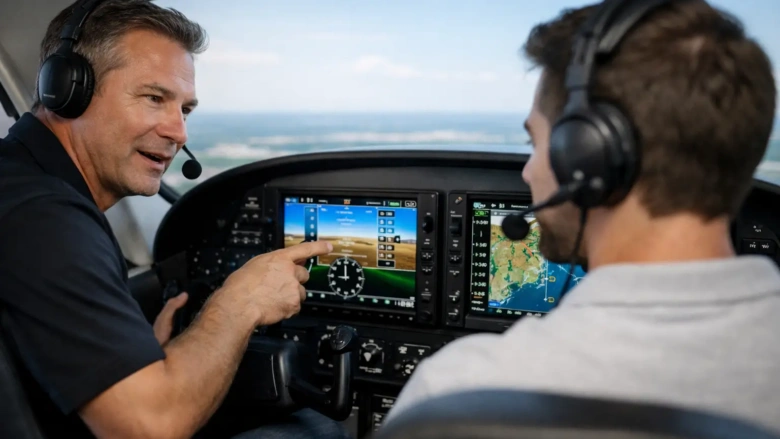
A strong commercial training program usually has a structured syllabus, dependable aircraft access, instructors who understand career pathways, and a fleet that reflects modern training standards. Garmin-equipped aircraft, simulator integration, and clear stage-based progress tracking are not just nice features. They help students build habits that carry into advanced training and professional operations.
Mentorship matters too. A good instructor does more than prepare you for a checkride. They help you build the judgment, discipline, and consistency that future employers and advanced examiners will expect. That professional mindset starts well before your first paid flying job.
Common mistakes students make during commercial training
One of the most common mistakes is focusing only on hours. Time matters because the FAA requires it, but raw hours alone do not create a strong pilot. Students who chase the minimum without improving precision often spend more later fixing weak fundamentals.
Another mistake is delaying instrument training quality. If your scan, procedures, and workload management are weak, commercial training becomes harder than it needs to be. The best commercial students usually arrive with solid instrument habits and a disciplined approach to briefing, planning, and checklist use.
Some students also underestimate how much consistency matters. Flying once in a while may feel manageable financially, but it often increases total cost. When skills fade between lessons, you pay to relearn what you already covered.
Commercial pilot training guide for career-minded students
If your goal is a professional cockpit, think past the certificate. Ask how you will build time after commercial, whether you plan to instruct, and when multi-engine training fits best. Your commercial certificate opens the door, but your next decisions shape how quickly you move through it.
For many students, the smartest path is an integrated one: private, instrument, commercial, instructor, and multi-engine training in a system designed to keep progress visible. That approach can reduce transition friction between phases and make your training more efficient overall. It also helps you develop in a professional environment from the beginning rather than trying to switch into one later.
A school such as Riverside Flight Academy is built around that kind of progression, which can be especially valuable for Southern California students looking for a structured route from first lesson to professional credentials.
The strongest training decision is usually not the fastest-looking option or the cheapest-looking one. It is the one that gives you consistent access, honest expectations, and a clear path from student pilot to working aviator. Choose a program that treats your commercial training like part of a career, because that is exactly what it is becoming.