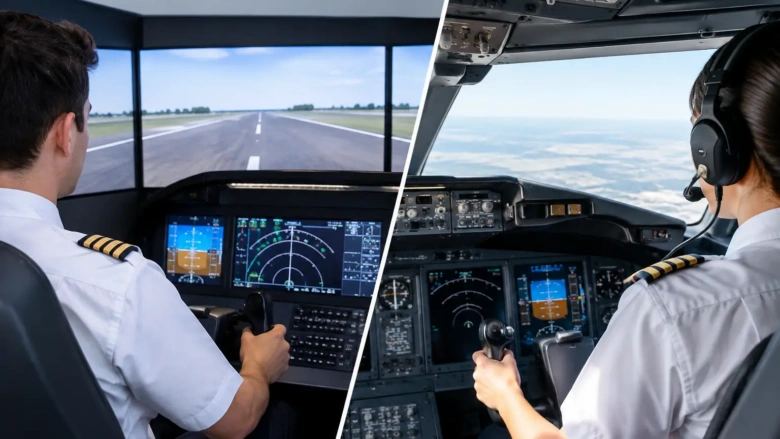
Your first ground school session may cover airspace, weather, aerodynamics, or the Federal Aviation Regulations. What it will not do is make you a pilot overnight. It gives you the decision-making foundation behind every safe flight. Knowing how to start ground school means choosing a training path that matches your goal, building a repeatable study routine, and connecting what you learn on the ground to what you will do in the aircraft.
For a future professional pilot, ground school is not a box to check before a written exam. It is the beginning of a disciplined system that will carry through instrument procedures, commercial operations, instructor training, and beyond. For a recreational pilot, it is just as valuable: the knowledge you gain helps you make sound choices when the weather changes, the radio gets busy, or a flight does not go exactly as planned.
Start With Your Pilot Goal
Ground school content is tied to the certificate or rating you are pursuing. Most first-time students begin with Private Pilot ground school, which prepares them for the FAA Private Pilot Airplane knowledge test and the oral portion of the practical test. It covers the rules, weather, navigation, aircraft systems, performance, aeromedical factors, and flight planning a private pilot needs to understand.
Before enrolling, be clear about what you want aviation to become. If your goal is to fly on weekends with friends and family, a private pilot program may be your immediate focus. If you are pursuing an airline, charter, corporate, or military-oriented career, start with the same private pilot foundation but choose a school that can provide a structured path through instrument, commercial, multi-engine, and flight instructor training.
That distinction affects more than your long-term schedule. Career-track students often benefit from a more consistent training cadence, formal progress checks, and ground instruction that is closely coordinated with flight and simulator lessons. Students flying for personal reasons may prefer greater flexibility. Neither route is automatically better. The right one is the route you can attend consistently and afford without creating long gaps in training.
How to Start Ground School With the Right Format
Ground school is commonly offered in three formats: instructor-led classroom training, live online training, and self-paced online courses. Each can prepare you for the FAA knowledge test when used well, but the learning experience is different.
A classroom program gives you a set schedule, direct access to an instructor, and accountability from fellow students. It is a strong choice for students who learn best by asking questions in real time or who want a professional routine from day one. In-person ground school can also make abstract subjects more practical, especially when an instructor uses local charts, weather scenarios, and aircraft systems examples.
Live online ground school offers much of that interaction while reducing travel time. This can work well for busy adults, college students, and students who live farther from the training airport. Confirm whether sessions are recorded, how questions are handled, and whether the program includes FAA knowledge test endorsement requirements.
Self-paced courses provide flexibility and can be effective for independent learners. The trade-off is that videos and practice questions cannot always tell you why an answer matters in the cockpit. If you choose this route, plan to review difficult subjects with a certificated flight instructor. A strong training program combines study materials with instructor guidance rather than treating test preparation as a solo task.
For students in Riverside, San Bernardino, and Los Angeles Counties, an organized ground school connected to regular flight training can reduce the friction between learning a concept and applying it. When you study density altitude one week and calculate takeoff performance before a lesson the next, the material sticks.
Confirm the FAA Requirements Early
You do not need prior flight experience to begin ground school. You also do not need to have every document in hand before your first class. Still, handling a few requirements early prevents costly delays once flight training gains momentum.
For most students, an FAA medical certificate should be addressed early in the process. A third-class medical is generally required before acting as pilot in command under private pilot privileges, while career-focused students should consider speaking with an Aviation Medical Examiner about the first-class medical standards they will eventually need. You do not necessarily need a first-class medical to start private pilot training, but discovering a medical issue after investing heavily in training is not ideal.
You will also need an FAA Tracking Number through the Integrated Airman Certification and Rating Application system before taking the knowledge test or applying for a certificate. Your instructor or school can help you understand when to create it and how it is used. Students who are not U.S. citizens may have additional training clearance requirements, so raise that question before setting a start date.
Ground school should also prepare you for the knowledge test endorsement. This endorsement confirms that you have received the required ground training or completed an approved home-study course and are ready to take the FAA exam. Do not assume buying an online course alone solves every administrative step. Ask exactly how your chosen program provides the endorsement and what scores it expects on practice exams.
Build a Study Schedule You Can Sustain
The students who progress most efficiently are rarely the ones who study for eight hours one Saturday and then disappear for two weeks. They create a manageable rhythm. For many new pilots, three to five study sessions per week of 30 to 60 minutes is more productive than occasional marathon sessions.
Start with the syllabus rather than jumping between random videos and question banks. A logical sequence usually begins with the fundamentals of flight, the aircraft, and regulations, then moves into weather, navigation, cross-country planning, and performance. Some topics overlap, so expect to revisit them. Weather becomes more meaningful once you understand altitude, pressure, and aircraft limitations. Navigation becomes more useful once you can read a sectional chart and calculate basic performance.
Use practice questions to identify weak areas, not to memorize letters. The FAA knowledge test evaluates understanding, and the practical test will require you to explain your reasoning to an examiner. If a question about a weather report is confusing, go back to the source material until you can interpret the report without relying on a familiar question format.
Keep a notebook or digital study log with questions for your instructor. Write down the concept, the source of confusion, and any calculation that did not make sense. Specific questions lead to better instruction than saying, “I do not understand weather.” For example: “Why does a warm front produce different cloud patterns than a cold front?” That question opens a useful conversation about forecasting and flight decisions.
Connect Every Lesson to Flight Training
Ground school works best when it is not isolated from the airplane. Before each flight lesson, review the maneuver, regulation, or weather concept you are likely to use. Afterward, spend ten minutes noting what matched the textbook and what surprised you.
A lesson on stalls is more than an aerodynamic definition. It explains why angle of attack matters and why coordinated flight, airspeed awareness, and proper recovery technique are essential. A lesson on airspace is not simply memorizing colors on a chart. It is learning where you can fly, what equipment is required, and when you need to communicate with air traffic control.
Simulator sessions can make this connection even stronger. They allow you to practice avionics workflow, radio procedures, navigation, and abnormal scenarios without the cost and time pressure of an airborne lesson. Modern Garmin-equipped training aircraft add another layer: learn the fundamentals first, then learn how technology supports, rather than replaces, sound pilot judgment.
Choose Instruction That Builds Judgment, Not Just Test Scores
A ground school should help you pass the FAA knowledge test, but a high score is not the final objective. The real standard is whether you can use the information to make conservative, informed decisions.
Look for instructors who can explain the practical reason behind a rule or procedure. A professional program should include scenario-based discussion: a deteriorating forecast, a cross-country fuel decision, a runway change, or an unexpected equipment issue. These conversations turn regulations and charts into operational judgment.
At Riverside Flight Academy, pilot-led ground and flight training can help students move from foundational knowledge to structured certificate progress. The best time to ask questions is before you are alone in the cockpit, not after.
Know When You Are Ready for the Knowledge Test
There is no advantage to rushing into the FAA knowledge test before you are consistently ready. Most students should complete their assigned ground modules, understand their weak areas, and achieve strong, repeatable scores on full-length practice exams before requesting an endorsement.
Schedule the test at a time when you can arrive rested and unhurried. Bring the required identification and approved testing materials, and know the testing center’s procedures in advance. After the exam, keep your results. Any missed knowledge areas may be discussed during your practical test preparation, and reviewing them with your instructor is part of becoming a more complete pilot.
Ground school begins with a chart, a regulation, and a first set of unfamiliar acronyms. Stay consistent, ask precise questions, and treat every subject as a future cockpit decision. That approach gives your training the momentum to move from a first lesson to a pilot certificate with confidence and purpose.