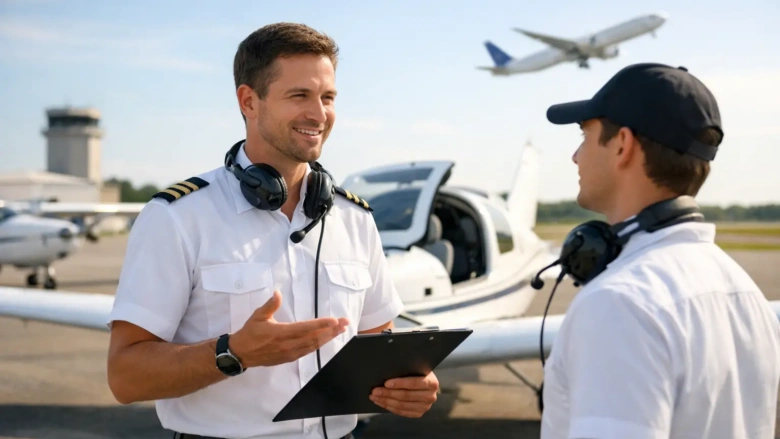
The first surprise for many new students is that flight training does not start with the airplane. It starts with judgment, systems knowledge, weather, regulations, and decision-making. That is why online private pilot ground school has become such a practical entry point for serious training. If you want to move efficiently from first lesson to checkride, the quality of your ground training matters as much as your time in the cockpit.
For some students, online learning is simply more convenient. For others, it is the difference between training consistently and falling behind. Work schedules, college classes, commute times, and aircraft availability all affect how quickly you progress. A good online program gives you a way to keep building knowledge even on days when you are not flying.
What online private pilot ground school actually does
Ground school prepares you for the FAA knowledge test, but that is only part of the job. It also builds the foundation for your flight lessons. When you already understand airspace, weather reports, aircraft systems, performance calculations, and radio procedures, your instructor spends less time explaining basics in the briefing room and more time helping you apply that knowledge in the airplane.
That connection matters. Students often think of ground school as a separate academic hurdle, but in strong training programs it is tied directly to flight progress. Learn stalls and aerodynamics on the ground, and slow flight makes more sense in the air. Learn cross-country planning properly, and navigation lessons become far more productive. Ground knowledge is not just test prep. It is operational training.
Online delivery works especially well for this phase because much of the material benefits from repetition. You may need to review weather theory three times before it clicks. You may want to replay a lesson on airspace the night before a flight. A classroom session happens once. An online lesson can be revisited until you own the material.
Why students choose an online private pilot ground school
The biggest advantage is flexibility, but flexibility alone is not enough. The right program also creates structure. That balance is what helps students stay on track.
If you are training while working full time, online study lets you make progress early in the morning, at night, or between other commitments. If you are a college-age student building toward a professional aviation path, it allows you to keep momentum between flight blocks. If you are starting from zero experience, it gives you room to absorb unfamiliar concepts at your own pace without feeling rushed by a live classroom.
There is also a cost and efficiency angle. Flight lessons are expensive. Using aircraft time to cover material that should have been learned before the lesson is not a smart use of your training budget. Students who show up prepared typically perform better, need fewer repeated explanations, and can move through lesson objectives more cleanly. That does not mean online ground school makes training easy. It means it removes avoidable friction.
The trade-off is accountability. Some students thrive with self-paced learning. Others start strong, then let lessons pile up. If you know you do better with deadlines, instructor check-ins, or a clearly sequenced syllabus, choose a school that blends online study with active support from instructors.
What to look for in an online private pilot ground school
Not every course is built for the same kind of student. Some are designed mainly to help you pass the written exam quickly. Others are built to support full training from first lesson through checkride. For most serious students, the second option is far more useful.
A strong program should follow a logical training flow, not just a collection of videos. You want lessons that move from fundamentals into applied topics in a way that matches real flight training. The content should cover FAA requirements thoroughly, but it should also explain how the information shows up in actual flying decisions.
Clarity matters more than production style. Slick graphics do not help much if the instruction is shallow. Look for material that explains not only what a rule says, but why it matters in the cockpit. When a course teaches weather minimums, for example, it should connect that topic to risk management, visibility, terrain, and real go or no-go judgment.
Good progress tracking is another sign of a serious program. Quizzes, lesson checkpoints, and knowledge reviews help you identify weak areas before they become bigger problems. The best online private pilot ground school options also make it easy for your instructor to see where you are, what you have completed, and what needs reinforcement.
The best results come from integrated training
Online ground school works best when it is not isolated from the rest of your training. Students progress faster when ground lessons, simulator sessions, and flight lessons support each other instead of operating as separate pieces.
For example, if you study navigation, weather briefing, and flight planning online during the week, then practice that same cross-country workflow with an instructor or simulator session, the learning becomes practical immediately. If you study aircraft systems before a lesson on emergency procedures, you are better prepared to understand what the airplane is telling you and why the checklist matters.
This is where a structured academy environment can make a major difference. A pilot-led school that aligns online study with a defined syllabus, instructor oversight, and consistent aircraft access gives students a clearer path than a stand-alone course ever could. Riverside Flight Academy takes that approach because efficient training depends on continuity. Knowledge, simulation, and flight time should build together.
Common mistakes students make
One of the biggest mistakes is treating ground school like a box to check before the written exam. That mindset usually shows up later in training, when a student has memorized answers but cannot explain weather trends, performance limits, or airspace decisions with confidence. The FAA knowledge test matters, but the real goal is safe and competent flying.
Another common mistake is waiting too long to start. Some students think they need to log several flight lessons before beginning ground training. Usually the opposite is true. Starting ground school early gives context to your first lessons and reduces confusion during the initial phase of training.
Students also underestimate how much consistency matters. Studying one weekend a month is rarely enough. Even short, regular sessions create stronger retention. Three focused evenings each week usually produce better results than one long cram session.
Finally, many students choose a program based only on price. Cost matters, but the cheapest option is not always the best value. If a weak course leads to slower flight progress, extra instructor time, or repeated lessons, the savings disappear quickly.
How to know if online is right for you
Online learning is a strong fit if you are self-directed, comfortable with technology, and able to follow a schedule without constant supervision. It is also ideal if your calendar is irregular or if driving to a classroom every week would make training harder to sustain.
If you learn best through live discussion, immediate feedback, and face-to-face accountability, a hybrid approach may be better. Many students do best when they complete the core knowledge work online and then reinforce it through instructor-led briefings. That combination gives you flexibility without losing mentorship.
For students in Southern California, where schedules, traffic, and training logistics can easily eat into available time, online ground school can be especially useful. It allows you to keep progressing on knowledge even when your day is full. That matters if your goal is not just to start training, but to finish efficiently.
Choosing a program that supports your long-term goals
If your private certificate is the first step toward an instrument rating, commercial training, and eventually instructing or airline work, your ground school should reflect that level of seriousness. You want a program that teaches good habits from day one – disciplined study, sound aeronautical decision-making, and respect for standards.
That does not mean the course needs to feel rigid or overwhelming. It means the training should be organized, professionally taught, and connected to real flight operations. The best online programs make students more confident because they reduce guesswork. You know what to study, why it matters, and how it applies to the next stage of training.
A strong start in ground school pays off long after the written exam is done. It shows up in better briefings, sharper cockpit decisions, smoother checkride prep, and a more professional mindset overall. If you choose an online private pilot ground school that is built around real progress rather than just convenience, you are not only preparing to pass a test. You are preparing to become the kind of pilot others trust to make good decisions when it counts.