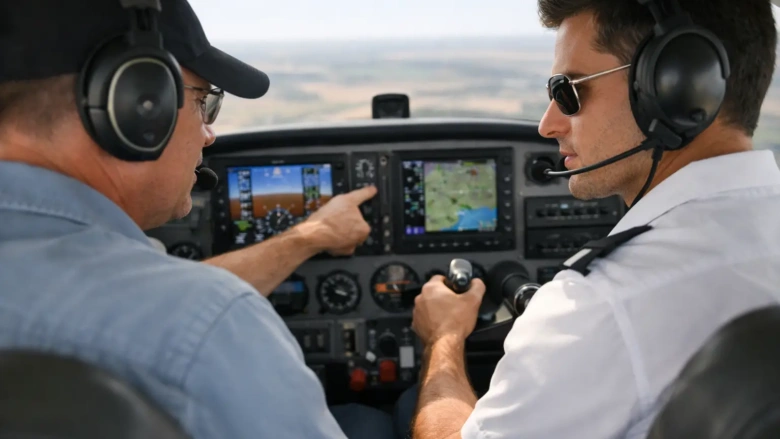
The first time you advance the throttles in a twin, the airplane tells you right away that this is not just “more of the same.” Multi engine rating training introduces new performance, new systems, and a very different set of decisions when things do not go as planned. For pilots aiming at commercial, charter, corporate, or airline flying, that shift matters.
A multi-engine airplane gives you more capability, but it also demands better discipline. You are managing asymmetric thrust, higher-performance systems, and faster aircraft that can reward precision or expose weak habits quickly. That is why good training is not about checking a box. It is about building judgment you can carry into every advanced stage of your flying career.
Why multi engine rating training matters
Pilots often pursue a multi-engine rating because it strengthens their resume and opens the door to more professional opportunities. That is true, but the deeper value is in what the training does to your flying. It forces you to think ahead, stay organized, and understand aircraft performance in a more exact way.
In a single-engine trainer, many mistakes can be corrected with time and altitude. In a twin, the margin can shrink faster. Engine-out scenarios, drag management, climb performance, and directional control all become more consequential. You are no longer just learning to operate a different airplane. You are learning to recognize how quickly conditions can change and how calmly you need to respond.
For career-track students, this rating is often a logical next step after commercial single-engine training. For experienced private pilots, it can also be the beginning of a more capable type of flying. The right timing depends on your goals, budget, and how recently you have flown at a high standard.
What you actually learn in multi engine rating training
The training itself is focused and technical, but it should never feel abstract. Every lesson needs to connect systems knowledge to in-flight decision-making.
Multi-engine aerodynamics and control
One of the biggest training areas is asymmetric flight. When one engine produces thrust and the other does not, the airplane wants to yaw and roll. That is where concepts like critical engine, Vmc, accelerated control inputs, and proper rudder use become practical rather than theoretical.
You will learn why “dead foot, dead engine” works as an identification aid, but also why that phrase alone is not enough. Good pilots verify before acting. Training should teach you to identify, verify, and respond in the right order, without rushing into the wrong engine shutdown.
Performance planning
Twin-engine airplanes do not guarantee strong climb performance after an engine failure. In some conditions, especially at high density altitude or heavy weights, performance may be marginal. That reality surprises some pilots.
A strong course teaches you to calculate takeoff distance, accelerate-stop and accelerate-go considerations where applicable, single-engine climb expectations, and the effect of temperature, elevation, and loading. If you train in Southern California, where terrain, heat, and busy airspace are all part of the environment, those calculations become even more relevant.
Systems knowledge
Most twins add complexity in fuel, electrical, propeller, landing gear, and engine systems. Constant-speed propellers, retractable gear, cowl flaps, alternator management, and fuel crossfeed are not difficult to learn, but they do require a higher level of systems understanding.
This matters because advanced flying is rarely about memorizing a checklist. It is about knowing what the airplane is doing, why it is doing it, and what you should prioritize first. The best students are not always the fastest with flows. They are the ones who understand the machine well enough to stay ahead of it.
Emergency procedures and judgment
Engine failures are the headline item in multi-engine training, but the rating is really about judgment under pressure. You will practice engine-out after takeoff scenarios, in-flight engine shutdown and restart procedures where appropriate, single-engine approaches, and decision-making around whether the safest choice is to continue, divert, or land as soon as practical.
This is also where instructor quality matters. Good training does not turn emergencies into dramatic theater. It teaches a stable process. Maintain control, configure correctly, verify the problem, and make the next safe decision.
Who should start now and who may want to wait
Not every pilot should jump into multi-engine training the moment the idea comes up. If your recent flying has been inconsistent, or your instrument and commercial-level skills are rusty, you may get more value by sharpening those first.
Pilots who tend to do well in this course usually arrive with solid checklist discipline, accurate airspeed control, and good radio habits. You do not need to be perfect, but you should be current enough that basic aircraft control is automatic. The rating moves faster when your brain is free to absorb new systems and procedures instead of relearning fundamentals.
If you are pursuing aviation as a career, there is also a practical timing question. Some students earn the rating soon after commercial single-engine so they can keep momentum. Others wait until they can pair it with time building, instructor pathways, or a broader professional plan. Neither choice is universally right. The best approach is the one that supports steady progress without stretching your budget so thin that training gets interrupted.
What to expect from the training process
Most multi-engine add-on courses are shorter than primary training, but they are more compressed. You are expected to show up prepared. The ground portion covers systems, limitations, V-speeds, aerodynamics, and procedures, then the flight portion applies those concepts quickly.
That pace is one reason structure matters. In an organized program, each lesson builds on the last instead of repeating the same weak points because of aircraft scheduling gaps or inconsistent instruction. A reliable fleet, simulator support when appropriate, and instructors who teach to a clear standard can make a major difference in both cost and completion time.
You should also expect a higher level of preflight planning. In multi-engine flying, a casual briefing is not enough. You need to know your numbers, know your flows, and know your immediate actions before the airplane moves. That may feel demanding at first, but it is exactly the kind of professional habit that employers expect later.
How to choose the right school for multi engine rating training
Not all multi-engine programs deliver the same value. The airplane matters, but the training environment matters just as much.
Look for a school with dependable aircraft availability, instructors who have real experience in advanced training, and a process that keeps you moving. If the aircraft is frequently down for maintenance, or if scheduling stretches lessons too far apart, you can lose both proficiency and confidence. That is expensive.
It also helps to train in an environment that mirrors real operational demands. Busy airspace, controlled airports, and modern avionics all add value when introduced in a structured way. At a school like Riverside Flight Academy, that kind of professional setting can help students connect the rating to the larger goal rather than viewing it as an isolated step.
Ask practical questions. How often do students fly during the course? What avionics are in the airplane? Is there simulator integration? What standards do instructors use for stage readiness? Serious schools will answer clearly because serious students should expect clarity.
Common mistakes pilots make
The most common mistake is underestimating the academic side. Some pilots assume they already know enough because they have strong single-engine experience. Then they discover that systems, limitations, and engine-out procedures require much more precision than expected.
Another mistake is chasing speed over retention. Finishing quickly is good if you are actually absorbing the material. It is not good if you are memorizing flows for a checkride and forgetting them a week later. The goal is not just to pass. The goal is to be safe and employable.
A third mistake is treating the rating as a one-time event. Multi-engine proficiency fades if you do not use it. Even after earning the rating, you should plan for recurrent practice, especially with engine-out procedures, instrument flying in twins, and systems review.
The real payoff
The biggest benefit of multi-engine training is not the extra line on your certificate. It is the mindset it builds. You start thinking more like a professional pilot because the airplane requires it. Your planning gets sharper. Your systems knowledge improves. Your tolerance for sloppy flying drops.
That payoff shows up long after the checkride. It matters when you transition into commercial operations, when you instruct advanced students, and when you are expected to make calm decisions in more demanding aircraft. Multi engine rating training is valuable because it raises your standard.
If you are considering the rating, approach it with the same seriousness you would bring to any major career step. Show up prepared, train in a structured environment, and aim for more than a pass. The pilots who get the most from this course are the ones who use it to become more precise, more disciplined, and more ready for what comes next.